WHEN LIGHT BECOMES PART OF THE PHOTOGRAPH
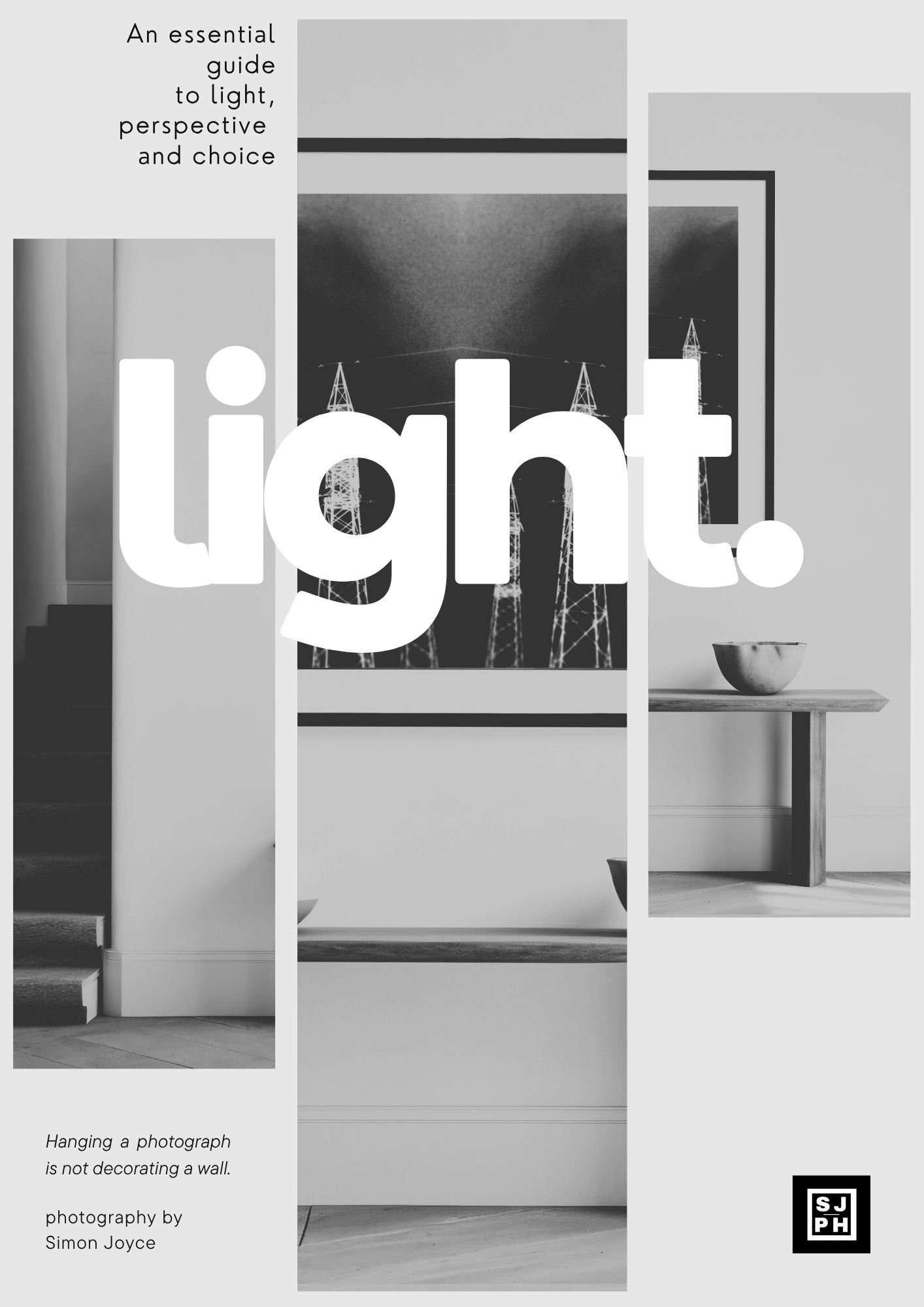
Cover photo of the guide ‘Light.’
How the right lighting can change the way a photograph lives on a wall
A photograph does not end when it is printed. It sounds obvious, but it is something easily forgotten. We spend enormous attention choosing the image, the paper, the dimensions and sometimes even the frame. Then we hang the photograph on the wall, switch on the lights and consider the job finished. It is not. The moment a photograph enters an interior, light becomes part of the work. Not metaphorically. Physically.
The same print can appear quiet or aggressive, warm or cold, flat or dimensional, intimate or distant depending on the light falling onto it. The image has not changed. Our perception of it has.
A photograph has more than one light
There is the light contained within the photograph and the light that reaches the photograph. They interact. A high-contrast black-and-white image may depend on deep blacks and delicate highlights. Strong direct illumination can flatten that relationship or create unwanted reflections. A photograph with subtle tonal transitions may need a softer, more controlled light to preserve those transitions. A colour image can change character considerably when illuminated by a warmer or cooler source.
This is particularly important with fine art prints. Paper is not simply a support for ink. Its surface, texture and reflectivity influence the way light is absorbed, reflected and perceived. The photograph therefore exists in two different conditions: as an image on a screen and as an object in a room. They are not the same experience.
Temperature changes perception
Light has a temperature, and temperature influences atmosphere. Warm light can introduce intimacy, softness and a sense of domesticity. Cooler light can make an image feel more precise, architectural or detached. Neither is inherently better. The question is whether the light belongs to the image and to the space in which it is displayed.
This is where lighting becomes less technical and more interpretative. Imagine a monochrome photograph dominated by shadow and negative space. Under a very warm light, its visual language may become unexpectedly softer. Under a cooler, more neutral source, the same image may recover a more analytical quality. The photograph has not changed. The room has changed the way we read it.
Direction matters too
Where the light comes from can be as important as its temperature. A light directed too aggressively towards a framed print may create reflections and reduce legibility. A source positioned with a more considered angle can illuminate the surface while preserving the visual depth of the image.
This becomes especially relevant with textured fine art papers. Texture is part of the physical experience of a print, but it also interacts with illumination. Light arriving at the wrong angle can exaggerate the surface in distracting ways. Light arriving with greater control can reveal materiality without allowing the material to dominate the image.
In other words, lighting should not compete with the photograph. It should allow the photograph to exist.
Not every photograph needs the same light
There is no universal lighting formula for photography on a wall. A minimalist image may benefit from restraint. A richly textured photograph may respond differently. A large monochrome print can become almost architectural within a room, while a smaller colour work may depend on a more intimate relationship with its surroundings.
The type of lighting matters too. Ceiling lights, wall lights, directional spots and dedicated picture lights create different relationships between artwork, wall and viewer. The choice should consider not only the photograph but also the architecture, furniture, viewing distance and the atmosphere of the room.
This is why lighting a photograph is ultimately part of interior thinking. The question is not simply: How much light does this photograph need? It is: What kind of light allows this photograph to become itself?
The wall is part of the composition
We often talk about composition as if it ends at the edges of the frame. In an interior, it does not. The wall becomes an extension of the photograph. The distance from neighbouring objects, the surrounding negative space, the colour of the wall and the direction of the room's light all influence how the work is perceived.
This is particularly important when choosing fine art photography for contemporary interiors. A photograph is not only something to look at. It becomes part of an environment. And that is why the presentation deserves the same attention as the image itself.
From photograph to object
There is a subtle shift that happens when an image moves from screen to wall. On a screen, the photographer controls almost everything: brightness, contrast, colour and the immediate viewing environment. On a wall, control becomes shared.
The architecture participates. The daylight changes. Artificial lighting takes over in the evening. The viewer moves closer or further away. The print acquires a physical presence that a screen cannot reproduce.
This is not a limitation. It is one of the reasons fine art printing remains so interesting. A photograph becomes something that lives with you. And once it does, light becomes part of its life.
Light is not decoration
Good lighting should not announce itself. It should not make a photograph look spectacular for five minutes and exhausting for five hours. It should support the image, preserve its character and allow the viewer to remain with it.
The best light can be almost invisible. You notice the photograph. Not the lamp.
Light is a short, 12-page guide by Simon Joyce Photo exploring the relationship between photography and illumination, with particular attention to light temperature, direction and lighting types. The guide is designed as a practical starting point for understanding how a photograph can be presented and experienced within an interior.
Want to go deeper?
Light is a free 12-page guide by Simon Joyce Photo exploring temperature, direction and lighting types in the presentation of fine art photography.
Request the Light guide, fill in the form. Subject: Light.
Because making the photograph is only part of the process. The way light meets the print is part of the photograph too.
Photography by Simon Joyce Photo.