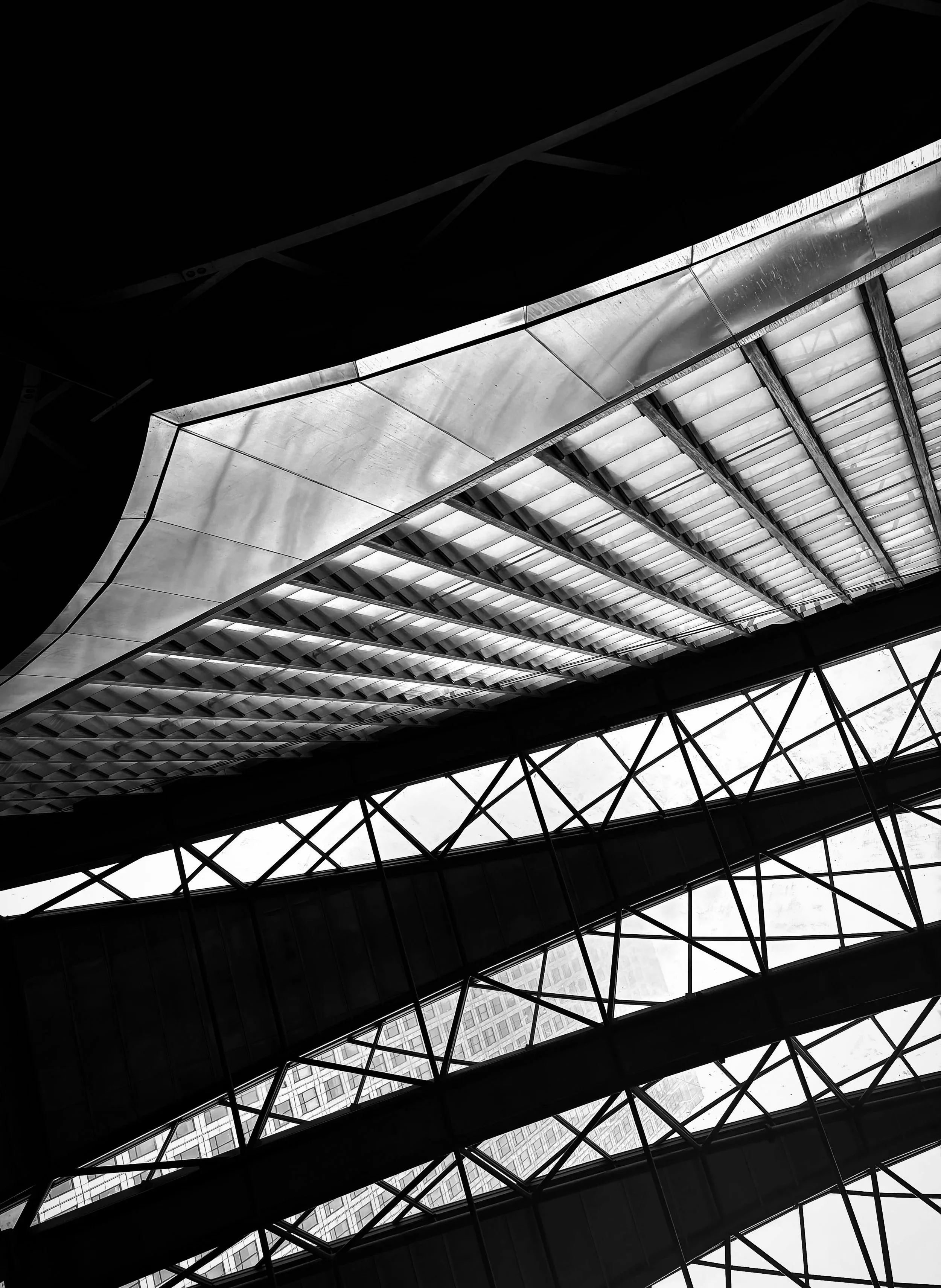
Canary Wharf Station - London
What an image leaves out is part of what it reveals.
Beyond the Subject
When we look at a photograph, our attention tends to settle on the most obvious element: a person, an object, a building or a particular detail. We search for something to recognise, something that gives the image an immediate meaning. Yet a photograph is rarely defined by its subject alone. What surrounds it, the distance between its elements and the areas that appear to contain nothing can be just as important.
Sometimes, the subject is only the beginning.
The space around it establishes a relationship. It can isolate, connect, balance or disrupt. It can make an ordinary object feel monumental, turn a familiar place into something unfamiliar or introduce a sense of uncertainty into an otherwise simple composition. The image becomes more than a record of something that existed in front of the camera. It becomes a way of organising perception.
Space Is Not Empty
In photography, empty space is often discussed in terms of composition. Negative space can simplify an image, direct attention towards the subject and create a visual balance. These are useful principles, but they describe only part of its potential.
Space does not necessarily need to provide balance. It can create tension. It can make an image feel uncomfortable, unstable or deliberately incomplete. A small detail surrounded by a vast area can appear vulnerable, isolated or unexpectedly powerful. The relationship between the two changes how we read both.
What matters is not simply how much space an image contains, but what that space does.
A wall, a shadow, a stretch of pavement or an area of uniform colour may seem secondary when considered in isolation. Within a photograph, however, these elements acquire a different role. They become part of a visual language, influencing the way we move through the frame and the associations we develop.
The absence of detail can be as deliberate as its presence. By removing visual information, a photograph can create room for attention to settle, for relationships to emerge and for meaning to remain unresolved.
What We Leave Unsaid
Photography is an act of selection. Every frame includes something and excludes something else. The photographer decides where to stand, what to retain and where the boundaries of the image should fall. Even when these decisions happen instinctively, they shape the experience of the photograph.
What remains outside the frame is not necessarily irrelevant. Sometimes, its absence is precisely what allows the image to suggest something beyond itself.
An incomplete view can encourage us to imagine what we cannot see. A figure facing away from us may raise more questions than a direct portrait. A doorway opening onto an unseen space can create a sense of possibility. A fragment of an object may carry more ambiguity than a complete representation.
This is not about making images obscure for the sake of obscurity. Nor does every photograph need a hidden message. It is about recognising that visual information does not have to explain everything in order to communicate something meaningful.
There is a difference between showing less and saying less. A photograph can be visually restrained yet conceptually rich. It can offer very little information while opening up several possible interpretations.
The viewer becomes part of this process. Meaning is no longer delivered as a finished statement; it develops through the encounter between the image and the person looking at it.
A Different Way of Seeing
Perhaps this is one of the most interesting possibilities photography offers: the opportunity to reconsider what we usually overlook.
We are accustomed to looking for the principal subject, the defining feature or the detail that makes a place recognisable. Yet sometimes the most compelling element is a relationship that would otherwise go unnoticed: a shape repeating itself across a surface, a shadow interrupting a geometric pattern, a small gesture changing the balance of an entire scene.
Seeing differently does not always require discovering something extraordinary. It may simply involve paying attention to the relationships between ordinary things.
For me, photography is a synthesis of aesthetics and meaning. An image is not merely a collection of visual elements, nor is it simply a message waiting to be decoded. Its form and its meaning develop together. A shift in position, a change in proportion or the decision to leave an area untouched can alter not only the appearance of a photograph but also the way it is understood.
The space between things is therefore not a secondary consideration. It is part of the image's structure and, sometimes, the very reason the image works.
What Remains Open
A photograph does not need to answer every question it raises. Its strength may lie in the possibility of sustaining attention beyond the first glance, allowing different readings to coexist without forcing them into a single conclusion.
The spaces within an image can create that possibility. They give visual elements room to breathe, but they also establish distances, suggest relationships and leave space for the imagination.
Perhaps the question is not simply what we choose to photograph, but what we allow to exist around it.
Because an image is shaped not only by what we place within the frame, but also by what we decide not to fill.
And sometimes, that is where its meaning begins.