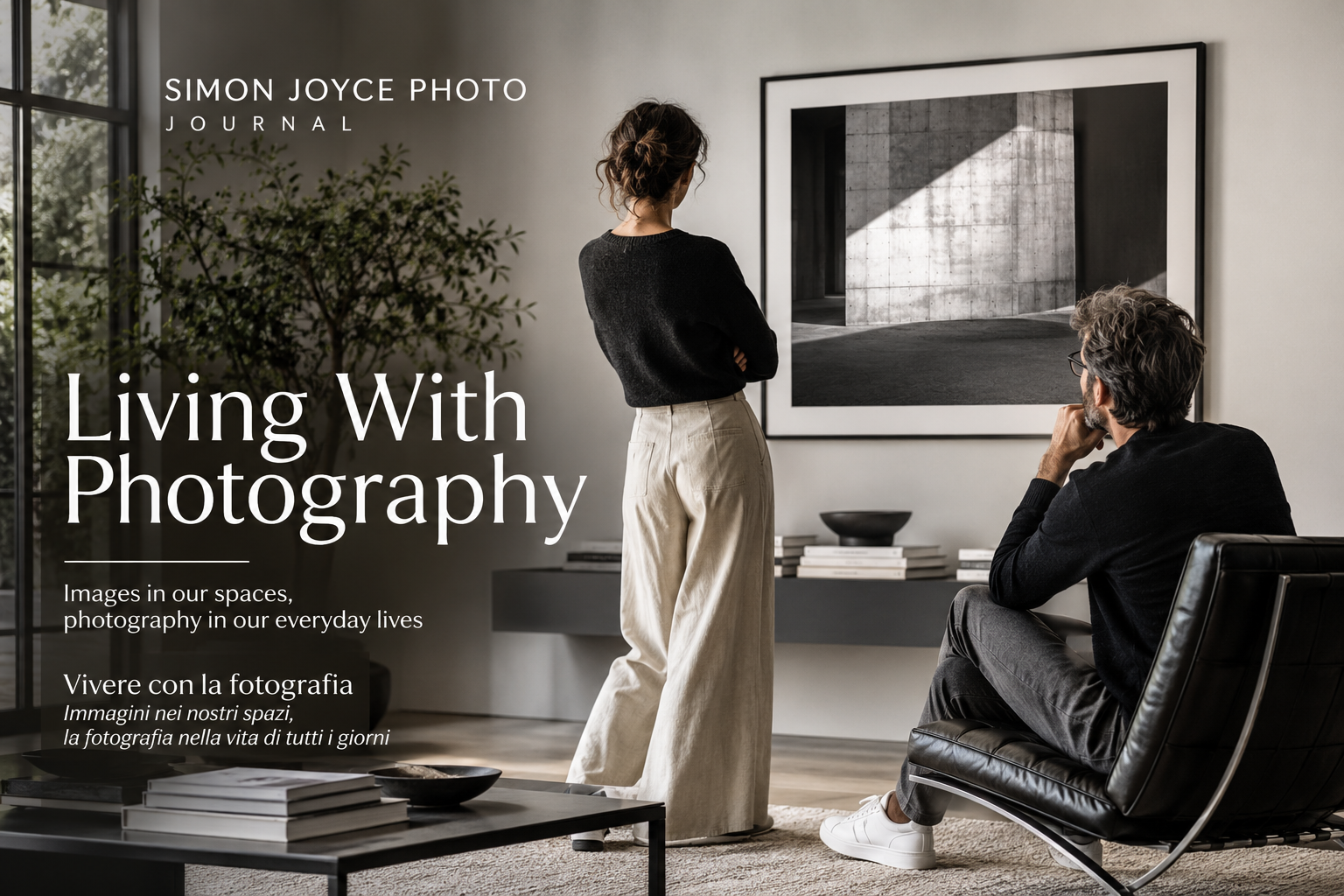
Images in our spaces, photography in our everyday lives.
Photography rarely ends when we take a picture. Sometimes, its most interesting life begins much later, when an image leaves the screen, finds a place on a wall, and becomes part of the environment we inhabit every day.
We live surrounded by images. Photographs are stored in our phones, shared across social media, viewed for a few seconds and quickly replaced by something new. Yet a photograph placed within a living space follows a different rhythm. It doesn't ask for immediate attention. It simply remains there, becoming part of our everyday experience.
An image becomes part of a place
A photograph in a home is more than a decorative object. It can change the atmosphere of a room, introduce a visual contrast, or create a point of interest that wasn't there before. Sometimes it is the first thing we notice when entering a space. At other times, we barely look at it, until a particular detail catches our attention again.
This relationship is rarely static. Light changes throughout the day, furniture moves, seasons change, and our own moods influence the way we perceive familiar things. The same photograph can feel different in the morning, in the quiet of an evening, or after months of living alongside it.
This is one of the reasons photography can work so naturally within contemporary interiors. It doesn't need to dominate a room. A carefully chosen image can coexist with architecture, materials, furniture and light, contributing to a space without overwhelming it.
Living with an image
Choosing a photograph for a home is also a personal decision. We may be attracted to a particular subject, but sometimes what draws us in is less obvious: a shape, a composition, a sense of space, an unexpected relationship between elements, or simply an emotion we cannot immediately explain.
Unlike images we encounter online, a photographic print gives us the opportunity to return to the same visual experience. We can observe it more slowly, notice things we missed, and allow its meaning to evolve over time.
A photograph doesn't necessarily have to tell us a story. It may leave questions unanswered, offer a different interpretation every time we look at it, or simply create a feeling that belongs to the space in which it exists.
Beyond decoration
The role of photography in interior design is often discussed in terms of colour, size, framing and placement. These elements matter, but the relationship between an image and a room is also emotional and subjective.
Art doesn't need to match everything around it. Sometimes the most interesting choice is an image that introduces a different tone, interrupts an established balance, or creates a subtle tension between the familiar and the unexpected.
Fine art photography can therefore be considered not only as decoration, but as a way of defining the character of a space. A photograph becomes part of the home, and the home becomes part of the way we experience the photograph.
Images that stay
In a world of constant visual consumption, living with photography offers a quieter alternative. It allows images to move beyond the moment of viewing and become part of our surroundings.
Whether an image is collected for its artistic value, chosen for a particular interior, or simply because it resonates with us, its presence can become meaningful in ways that are difficult to measure.
Perhaps the real value of living with photography lies precisely here: not in looking at an image once, but in allowing it to remain, to become familiar, and to continue offering something new.
At Simon Joyce Photo, photography moves between images, spaces and perceptions. Fine art prints are conceived not only to be viewed, but to find their place in contemporary living — becoming part of the spaces and experiences we call our own.